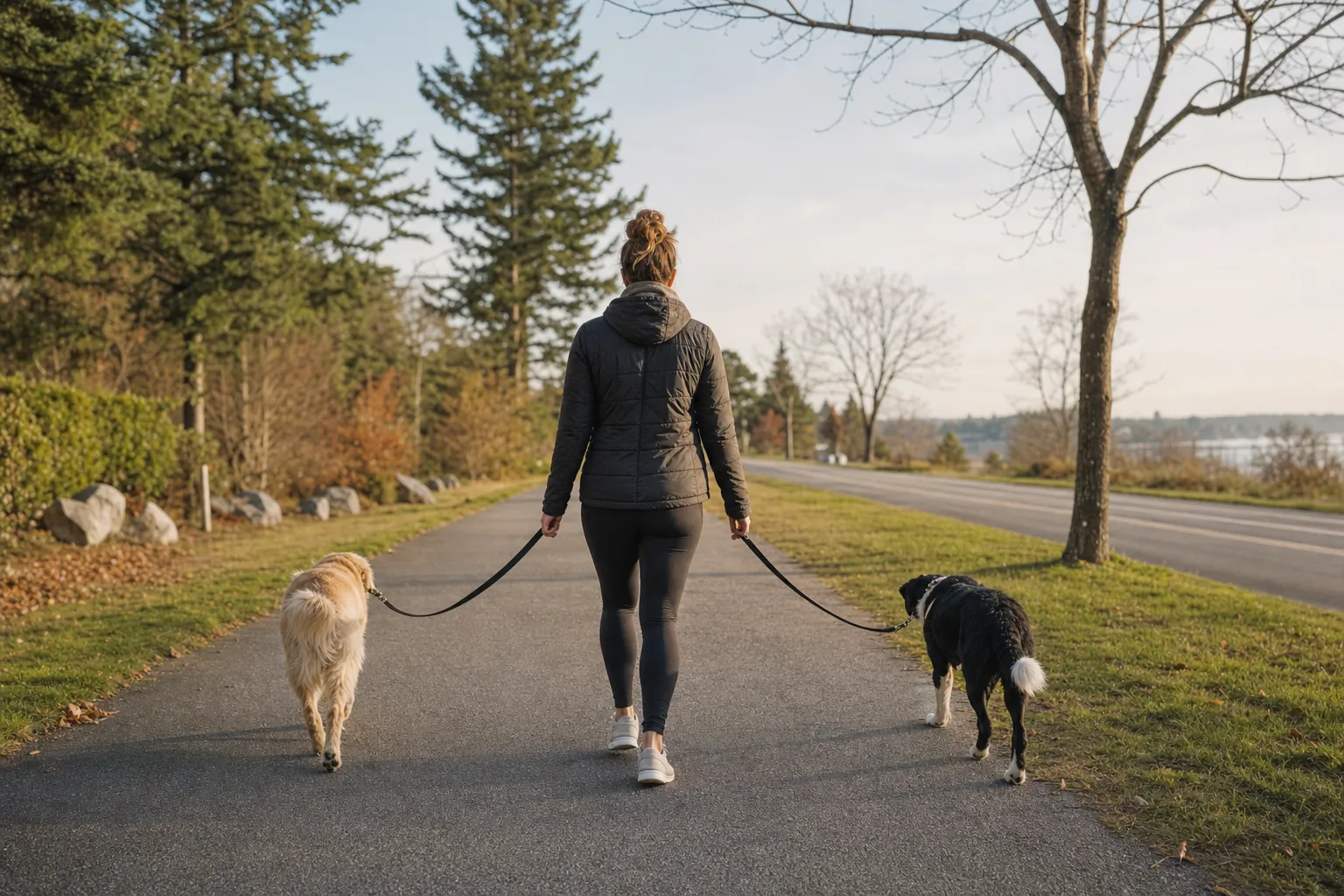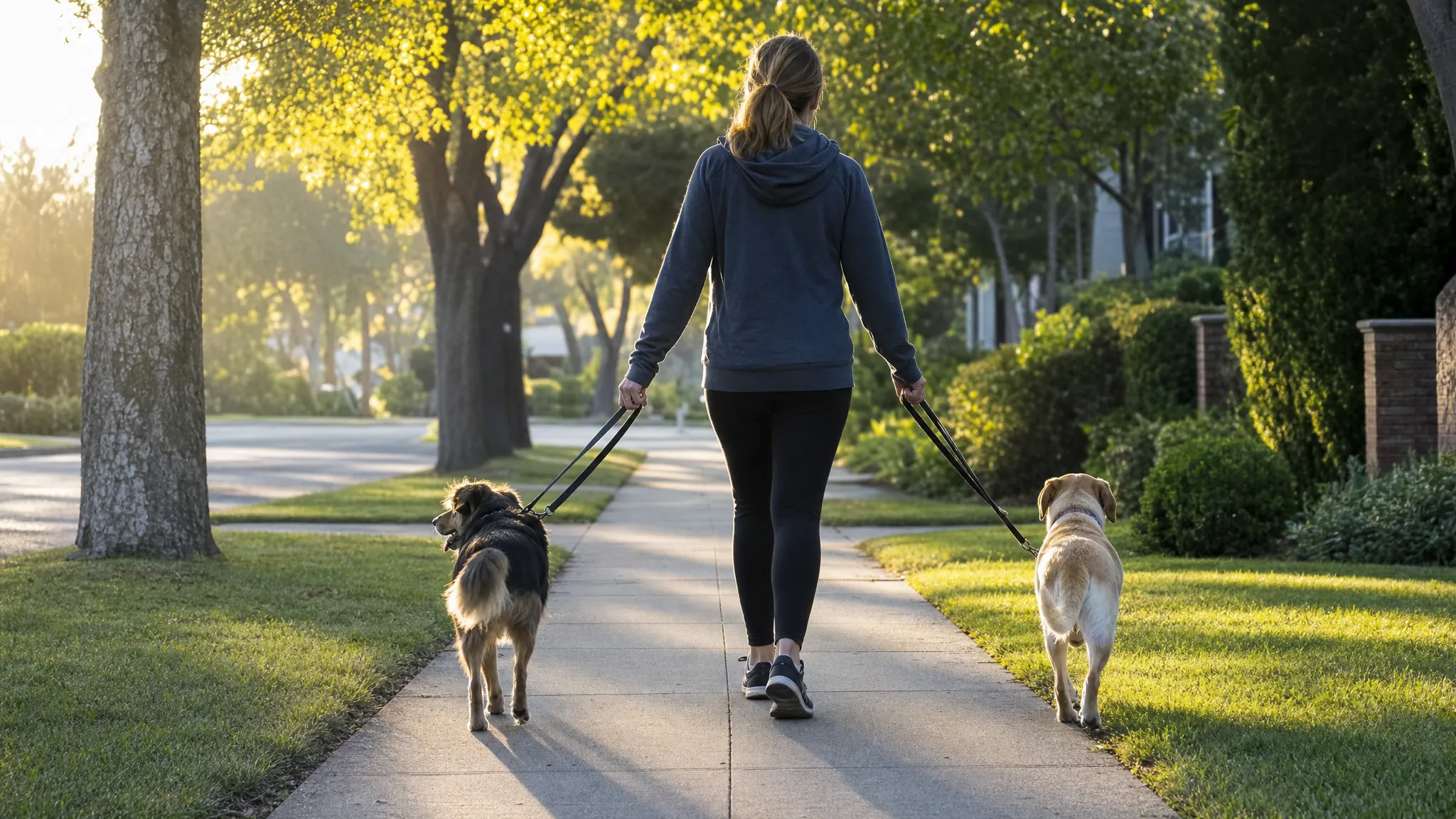
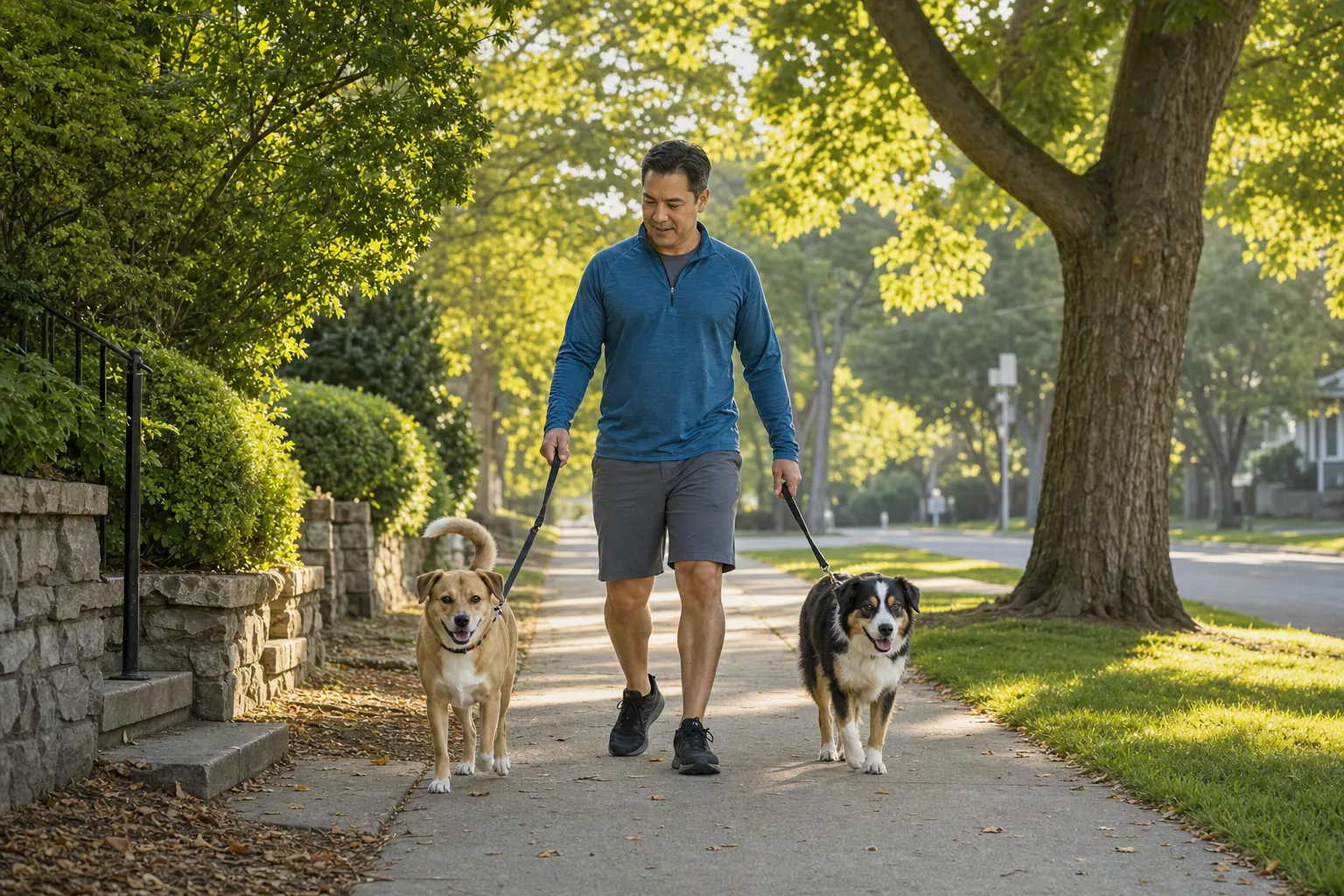
Walking two dogs at once is less about finding a clever grip and more about setting up a routine both dogs understand. When each dog can walk calmly on their own, a shared outing can become a relaxed part of the day. When either dog is pulling, worried, recovering, or easily overwhelmed, trying to manage both at once can turn a simple walk into a stressful one. Start with the easiest version of the job, then add challenge only after the group feels steady.
1. Decide whether the pair is ready to walk together
Before taking both dogs out, ask how each one behaves on a separate leash. A dog does not need perfect heelwork, but each should be able to move forward without constantly pulling, respond when you stop, and recover from ordinary distractions. If one dog freezes near traffic, lunges toward other dogs, or pulls hard toward every smell, that dog needs individual practice first. Walking together multiplies the number of choices you need to make in a few seconds.
Look at the pairing, not just the dogs individually. Similar pace helps, but similar comfort level matters more. A quick, confident dog may drag an older or timid companion into situations they would rather avoid. A small dog may need more room around strangers than a larger dog does. Separate leashes are the better choice whenever the dogs need different directions, different distances, or different kinds of support.
Set a realistic goal for the first outing. The goal is not distance. It is a short stretch where both dogs stay loose enough for you to make a calm turn, pause, and continue. The American Kennel Club’s guidance on walking multiple dogs also emphasizes working on basic leash manners before handling the group. The Animal Humane Society’s loose-leash guidance starts with small, rewarding repetitions, which is a useful approach before asking two dogs to work as a pair.
2. Set up the gear before either dog reaches the door
Preparation prevents the fumbled first minute that makes many two-dog walks feel harder than they need to be. Put everything in reach before you bring the dogs over: two secure collars or harnesses, two leads, treats if you use them, waste bags, water for a longer or warm walk, and your keys or phone. Check clips, stitching, and rings each time. A leash that looks fine from across the room can still have a sticky clip or worn webbing near the connection point.
For early practice, use two standard leashes. Independent lines let you shorten one dog’s distance without yanking the other dog along. They also make it easier to see who is creating tension. The American Kennel Club’s guide to choosing a dog leash recommends a 4 to 6 foot nylon leash as a practical starting point for training. The exact length is less important than having enough room for a natural stride without giving either dog enough line to cross in front of you.
Choose a side for each dog before you leave. Keep the same dog on the same side for the first several walks. A predictable setup gives the dogs fewer chances to weave and gives you a simple reset point when they do. Avoid wrapping leash loops around your wrist. Hold the handles securely, keep extra length gathered neatly, and stay ready to shorten the distance by stepping toward a dog rather than pulling backward.

3. Start with a five-minute practice route
The first shared walks should be intentionally boring. Pick a quiet block, an open park path, or a wide area where you can turn around without squeezing past people, dogs, cars, or bicycles. Begin with both dogs standing on their assigned sides. Take a few steps, then pause before anyone pulls. Reward calm attention in whatever way is normal for your dogs, whether that is a quiet word, a treat, or simply moving forward again.
Do not try to walk a full neighborhood loop just because both dogs made it out the door. Turn back while the group is still doing well. A short success is more useful than twenty minutes of crossed lines and frustration. Repeating a five-minute route lets the dogs learn that this is a different routine from a solo walk without asking them to solve every distraction at once.
Pay attention to the point where the walk changes. Maybe one dog gets excited at the mailbox, both dogs speed up near the park, or they start crossing when they see a squirrel. That is useful information, not a reason to push through. Next time, stop before that point, reset the dogs to their sides, and make the route just a little easier. Progress comes from stacking manageable walks, not from proving you can power through a chaotic one.
4. Keep the leashes quiet, short enough, and separate
Two dogs can create a surprising amount of movement even when neither is trying to pull. Keep your hands close to your body, with enough slack for comfortable walking but not so much that the dogs can cut in front of each other. If one dog drifts across, slow down rather than snapping the leash tight. Use a gentle turn, guide that dog back to their side, and restart once both lines are loose.
Try not to manage the entire walk with constant leash pressure. A tight leash can make dogs lean harder into the line, and it gives you less time to respond when something unexpected appears. Think of the leash as a safety connection, not a steering wheel. Your pace, turns, pauses, and repeated side assignments do more to organize the walk than a firm grip ever will.
When you need to shorten a dog’s distance, move your own feet first. Step closer to the dog, bring your hand toward your center, and create a smaller safe space before the distraction becomes a problem. This is especially helpful near driveways, narrow sidewalks, and intersections. Two independent leashes make these small adjustments clearer, which is why they are the better training setup for most households at the beginning.

5. Make turns and stops part of the routine
A simple turn is one of the best ways to regain attention without turning the walk into a correction. Practice turning away from mild distractions before you need it. On a quiet path, say the cue you normally use, turn in a gentle arc, and encourage the dogs to follow. Keep the turn wide enough that neither dog gets tangled around your legs. Repeat in both directions so one side does not become the awkward side.
Stops matter just as much. At a curb, driveway, or crowded section, pause with both dogs close enough that you can see their shoulders and leash lines. If one dog pulls forward, wait for even a moment of slack before moving on. The point is not to demand stillness for a long time. It is to teach the pair that stopping is ordinary, safe, and followed by forward movement once everyone is ready.
If the dogs cross, do not rush to untangle them while they keep moving. Stop, take a breath, and guide one dog back around you or behind the other dog with plenty of space. Treat the reset as part of the walk rather than a failure. Moving quickly while the lines are crossed is where people trip, handles slip, and dogs start to feel pressure from the wrong direction.
6. Plan for distractions before they arrive
Most difficult moments are predictable. Another dog appears at the end of the sidewalk. A delivery truck opens its door. A runner comes up behind you. A child calls to the dogs. Scan ahead often enough that you can make a choice early. Cross the street, turn down a quieter side path, step into a wide driveway, or simply wait at a distance. Giving your dogs space is not being dramatic. It is how you keep a manageable situation manageable.
Do not expect one dog to help regulate the other. Some pairs look calmer together, while others feed off each other’s energy. If both dogs are getting excited, create more distance sooner than you would with one dog. The ASPCA’s general dog-care guidance also stresses basic walk essentials such as identification, water, and attention to hot pavement. With two dogs, those ordinary details deserve more planning because a small interruption can become two separate needs.
It is fine to change the route or end a walk early. A walk is successful when both dogs come home safely and you still feel in control. That can be fifteen calm minutes on a quiet route instead of a longer loop through the busiest part of the neighborhood.

7. Know when separate walks are the kinder option
Walking two dogs at once is not a requirement for a multi-dog household. Separate walks are often better when a dog is learning loose-leash skills, recovering from illness or injury, fearful around people or animals, or much stronger than their companion. Use separate leads for a new route, a crowded event, a trip near heavy traffic, or any outing where one dog may need your full attention.
It is also reasonable to divide the walk by purpose. One dog may benefit from a slow sniffy stroll, while the other needs a steady exercise pace. One may enjoy greeting familiar people, while the other needs room. Trying to make both dogs do the same kind of walk can leave everyone frustrated. Individual walks are not less efficient if they give each dog a better experience and make the next shared attempt more likely to go well.
For households considering one shared setup later, the earlier double dog leash guide explains the differences between couplers, swivels, and retractable designs. That equipment makes the most sense after both dogs already have a dependable shared routine, not before.
When a shared leash can make the routine simpler
Once both dogs can walk at a similar pace, stay on their sides, and respond to a pause or turn, one shared setup may reduce the number of handles you carry. It is still worth keeping separate leads available for crowded routes and training days. The Broken Phoenix carries an Automatic Double Dog Leash with two retractable lines for households whose dogs are already comfortable walking as a pair. Review the current product details, then match any shared leash to your dogs’ size, habits, and the routes you actually walk.
For more everyday gear, browse the pet supplies collection or the full store. Before ordering, the shipping policy and return policy explain the practical details.
Frequently asked questions
Is it easier to walk two dogs with one leash or two?
Two separate standard leashes are usually easier for early practice because each dog can be guided independently. A shared leash can become convenient later when both dogs already walk calmly at a similar pace and do not need different levels of support.
What should I do if my two dogs keep crossing leashes?
Stop instead of trying to untangle the dogs while they continue moving. Guide one dog back to their usual side with a calm, wide reset, then continue only after both lines are loose. Consistent side assignments and short practice routes make crossing less likely over time.
Can I walk two dogs together if one dog pulls?
It is safer to work with the pulling dog alone first. A dog that pulls can make the second dog feel pressure and can leave you without enough control near traffic or distractions. Build each dog’s loose-leash skills separately, then add short shared walks in a quiet area.