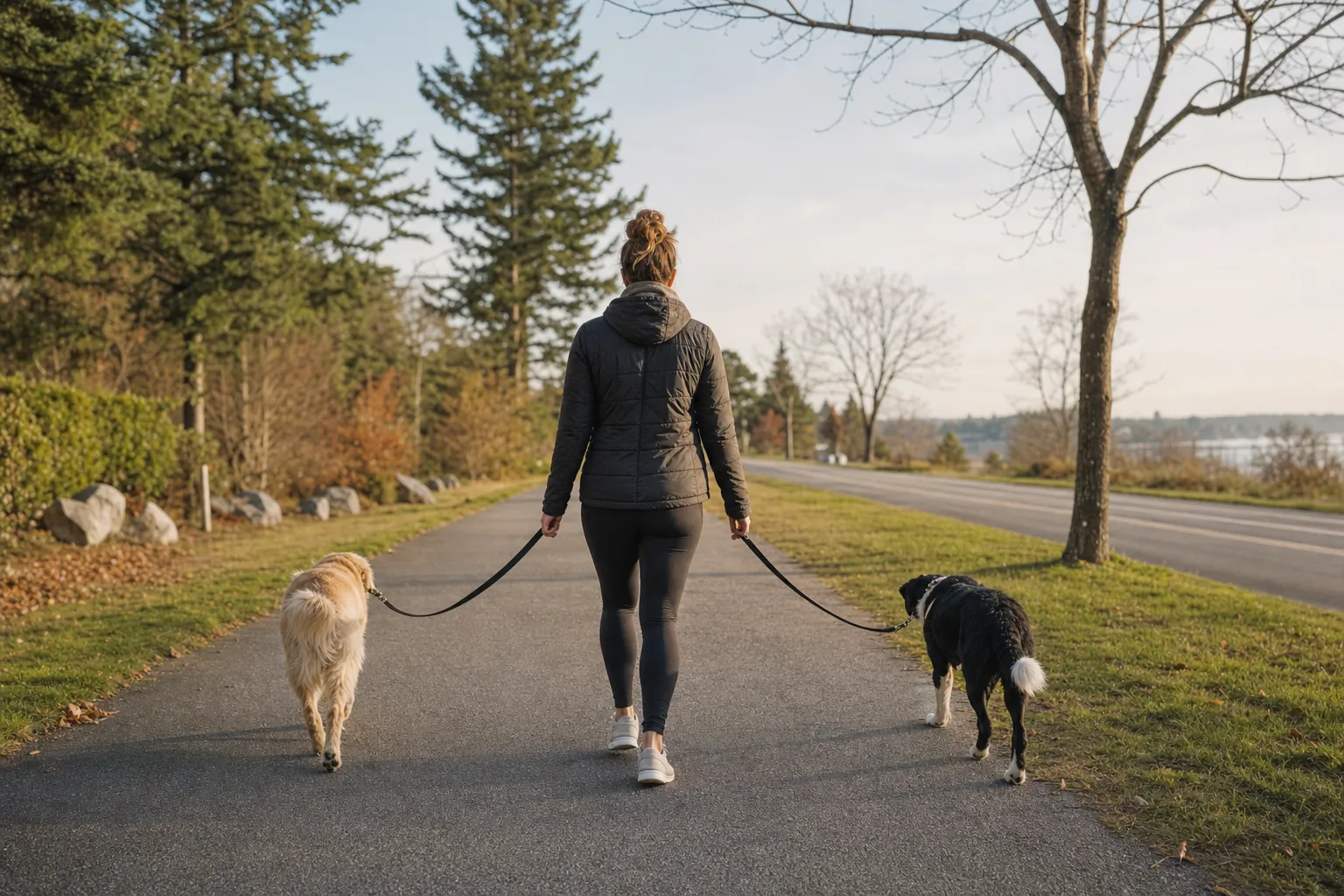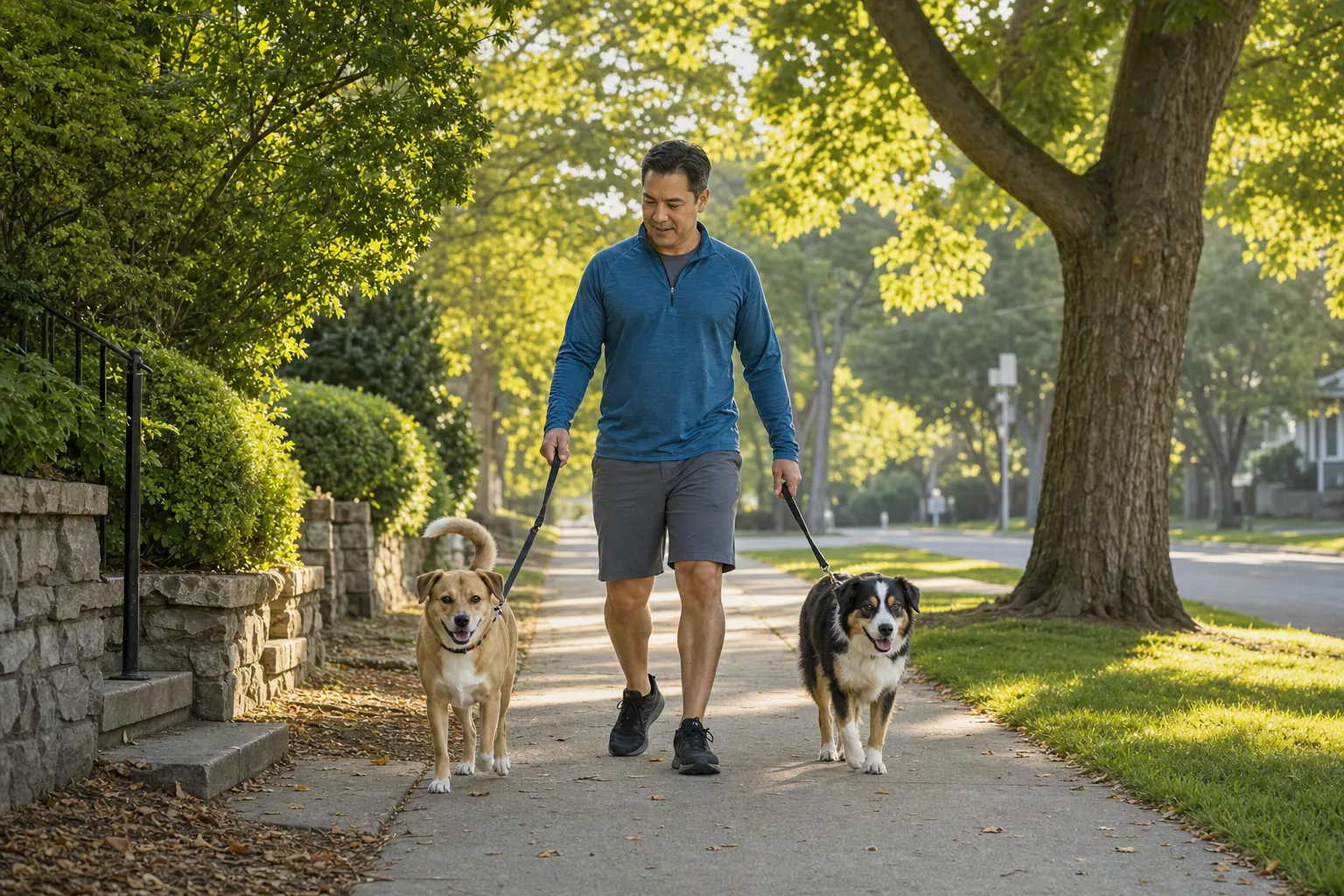
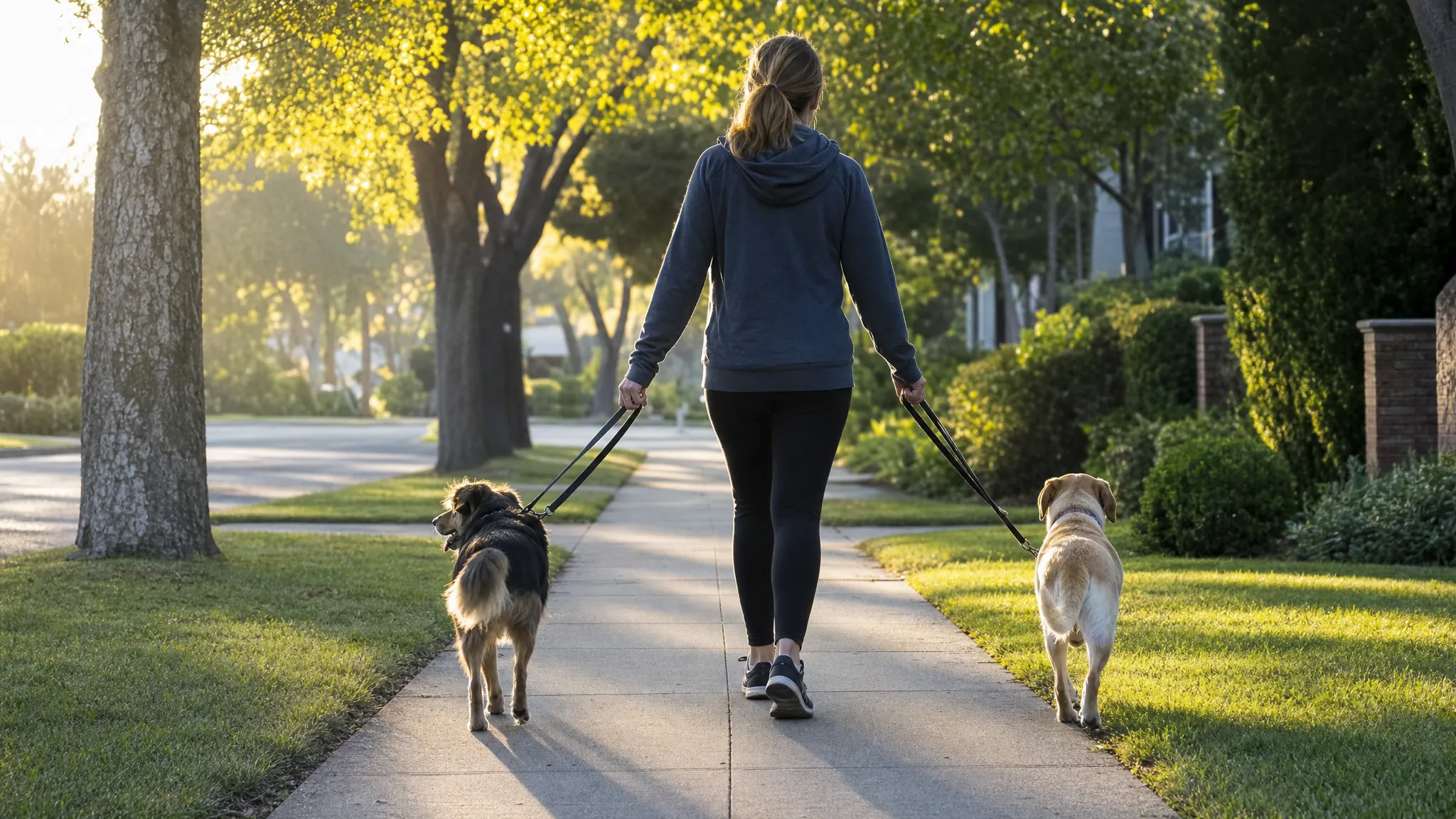
A no-tangle double dog leash can make a familiar walk feel simpler, but it cannot stop two dogs from changing sides, rushing toward the same scent, or needing different amounts of room. The least tangled walks come from a clear routine: choose each dog's side, start with a route that gives you space, and reset early instead of trying to untwist moving dogs. The equipment should support that routine, not replace it.
Why two leash lines twist in the first place
Most leash tangles are not a hardware failure. They happen because the dogs cross paths while the handler keeps moving. One dog drifts toward a smell, the other changes sides to greet someone, and suddenly both lines are wrapped around each other, a leg, or the handler's knees. A swivel or split point can reduce how much the hardware itself twists, but it cannot decide where two dogs walk.
Start by noticing the moment before the tangle. Some pairs cross near the curb. Others do it when they see another dog, stop to sniff, or leave the front door full of energy. The pattern matters because it tells you where to simplify the walk. If the dogs cross every time you pass a mailbox, do not wait for the lines to tighten. Slow down before that point, bring the pair back to their usual sides, and move through it with less distance between them.
A shared setup is best saved for dogs that already have manageable leash habits on their own. The American Kennel Club's advice on walking multiple dogs makes the same practical point: basic leash manners come first. If one dog is pulling, worried by other dogs, or still learning to settle near traffic, two separate leads give you more useful choices.
Give each dog a consistent side
Pick a left side and a right side before you leave the driveway. It sounds small, but it removes one decision from every turn, curb, and pause. Keep the more predictable dog on the side that makes the route easier for you. For example, if your neighborhood has a busy road on one side, place the dog who needs more help staying close on the side away from traffic when that is practical.
The side assignment does not need to be military precision. Dogs can pause to sniff and change position during a relaxed walk. The point is that you have a calm default to return to when the lines start to cross. Use the same short verbal cue each time, guide the dog back into the open space at your side, then continue. Repeating the same pattern is clearer than switching hands and improvising at every distraction.
For the first few walks, use a route with enough room to make gentle turns. Narrow sidewalks, crowded park entrances, and busy apartment hallways leave little margin when two dogs change direction. A quiet block or broad path gives the pair time to learn the pattern without being squeezed past people, bikes, or parked cars.

Set the line length before the walk gets busy
Too much loose line gives two dogs room to cross in front of you. Too little makes every normal movement feel tight and can create more pulling. Aim for enough space for a natural stride while keeping both dogs close enough that you can see their shoulders and change direction before they cut across each other.
With two separate standard leashes, keep extra length gathered neatly instead of looping it around your wrist. If you use a shared leash with independently extending lines, set the length for the route you are on rather than leaving both lines fully extended by default. A wide, quiet path can allow more room. A curb, blind corner, or approaching dog calls for less. The American Kennel Club's leash guide notes that excess line can create hazards, especially when a dog reaches the end of a retractable lead.
Check the practical parts before each walk: clips should close cleanly, the split point should move freely, and the lead should not be frayed near the hardware. A no-tangle label is not a substitute for inspecting the points that take the force. If a clip sticks or a retractable brake feels unreliable when the leash is empty, do not wait to find out how it behaves with two dogs moving.
Use the first minute as a calm setup
The doorway is where many walks start out tangled. Both dogs are excited, the leash handles are still being sorted, and the first person or car that passes can pull the pair in opposite directions. Slow that minute down. Attach one dog, then the other. Confirm the side assignment before the door opens. If one dog is bouncing, wait for a few seconds of stillness instead of trying to clip and leave in the same motion.
Once outside, do not immediately head toward the busiest part of the route. Take a few calm steps in the easiest available direction and check the leash lines. Are both dogs on their planned sides? Do you have enough slack for a normal step without enough spare line for them to cut across your knees? Are the handles or brake controls sitting comfortably in your hands? This early check is much easier than repairing the setup after the dogs have built speed.
It also helps to make the first pause predictable. Stop after a short stretch, let both dogs settle, then continue. That teaches the pair that a pause is ordinary, not a sign that something has gone wrong. If the first minute is already chaotic, make the next walk easier. A shorter route with a repeatable start is more useful than a long outing that begins with crossed lines every time.
Use a pause instead of pulling through a crossing
When the dogs begin to cross, stop walking. Trying to untangle the pair while they continue forward is where a quick twist becomes a tight knot. Pause before the lines pull against either dog, take a breath, and bring the dog who has crossed back around your outside. A wide, quiet reset is easier on the dogs and safer for you than reaching between moving lines.
Keep the reset boring. There is no need for a sharp correction or a frustrated rush. Simply stop, use the side cue you have been practicing, and move again once the lines are loose. The Animal Humane Society's loose-leash walking guidance is built around rewarding short, successful repetitions, which is a useful mindset here too. You are teaching the pair that a pause and repositioning are normal parts of the walk.
If the dogs cross repeatedly in the same few minutes, the route is probably asking too much right now. Turn toward a quieter area, shorten the outing, or return to separate walks for a few sessions. Finishing a calm ten-minute walk is more valuable than forcing a longer route that leaves everyone tense.

Make wide turns before a distraction forces one
A planned turn gives you more control than a last-second pull. Watch ahead for dogs, runners, delivery vehicles, open gates, and the places where your pair usually speeds up. When you see a likely distraction, make a gentle wide turn before both dogs reach the point where they want to cross. A curve gives each dog room to follow without cutting directly in front of the other.
Practice turns on an easy route first. Walk a few steps, say your usual cue, make a broad arc, and let the dogs follow through the open side. Practice both directions. Most people have one hand or one direction that feels less natural, and a quiet practice turn is the place to learn that, not a busy intersection.
At curbs and narrow passages, bring the dogs closer before you reach the squeeze point. Stop if you need a second to organize the lines. A calm pause looks less dramatic than trying to steer two dogs through a tight space with crossed leashes, and it gives you time to see where each dog is headed.

Choose the setup for the dogs you have today
A coupler, a swivel, or a double retractable leash can reduce the number of handles, but none of them are a universal answer. A fixed splitter often suits two dogs with a similar pace on a familiar route. A swivel can help reduce hardware twisting when dogs make small side changes. Independent lines can be useful when each dog needs a little more room to sniff. The right choice depends on the pair's behavior and the route, not a promise printed on the packaging.
Use two separate leads when the dogs need different distances, different directions, or different kinds of support. That includes a dog who is reactive, recovering, easily startled, much faster than the other dog, or still learning loose-leash skills. Separate walks can also be the better choice on a new route or in a crowded place. There is nothing inefficient about choosing the setup that lets you make a clear decision for each dog.
For a broader look at couplers, swivels, and retractable designs, read the double dog leash guide. If you are still building the basic shared routine, the step-by-step guide to walking two dogs at once is the better place to start.
When a shared leash earns its place
Once both dogs can keep a similar pace, return to their sides after a pause, and move through ordinary distractions without pulling, a shared setup may simplify the number of handles you carry. The Broken Phoenix offers an Automatic Double Dog Leash with two independently extending lines. Review the product details alongside your dogs' habits and the walks you actually take. Keep separate leads available for crowded routes and training days.
Browse the pet supplies collection for more everyday dog gear, or visit the full store when you are comparing categories. The shipping policy and return policy cover the practical order details.
Frequently asked questions
Do no-tangle double dog leashes really prevent tangles?
They can reduce twisting at the split point or in the hardware, but they cannot prevent dogs from crossing paths. Consistent sides, appropriate line length, early pauses, and wide turns do more to keep the walk clear.
What should I do when two dog leashes get crossed?
Stop before the lines become tight. Guide the dog who crossed back around the outside with enough room to reset, then continue when both leads are loose. Do not pull the dogs through the crossing while they are still moving.
Is a double dog leash safe for two dogs that pull?
It is usually better to work with each pulling dog separately first. A shared setup is most useful after both dogs can walk with manageable leash pressure and respond to a pause or turn.