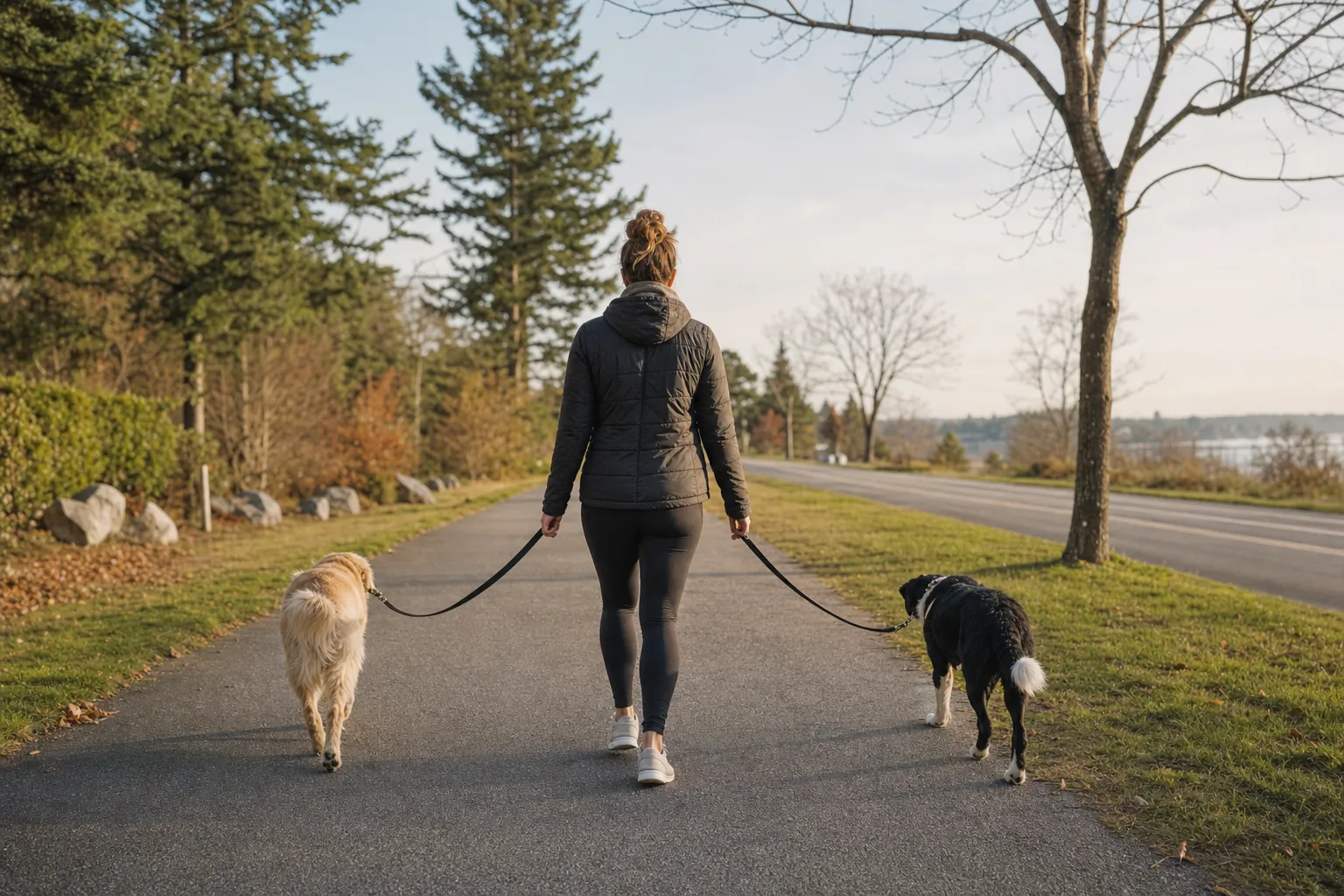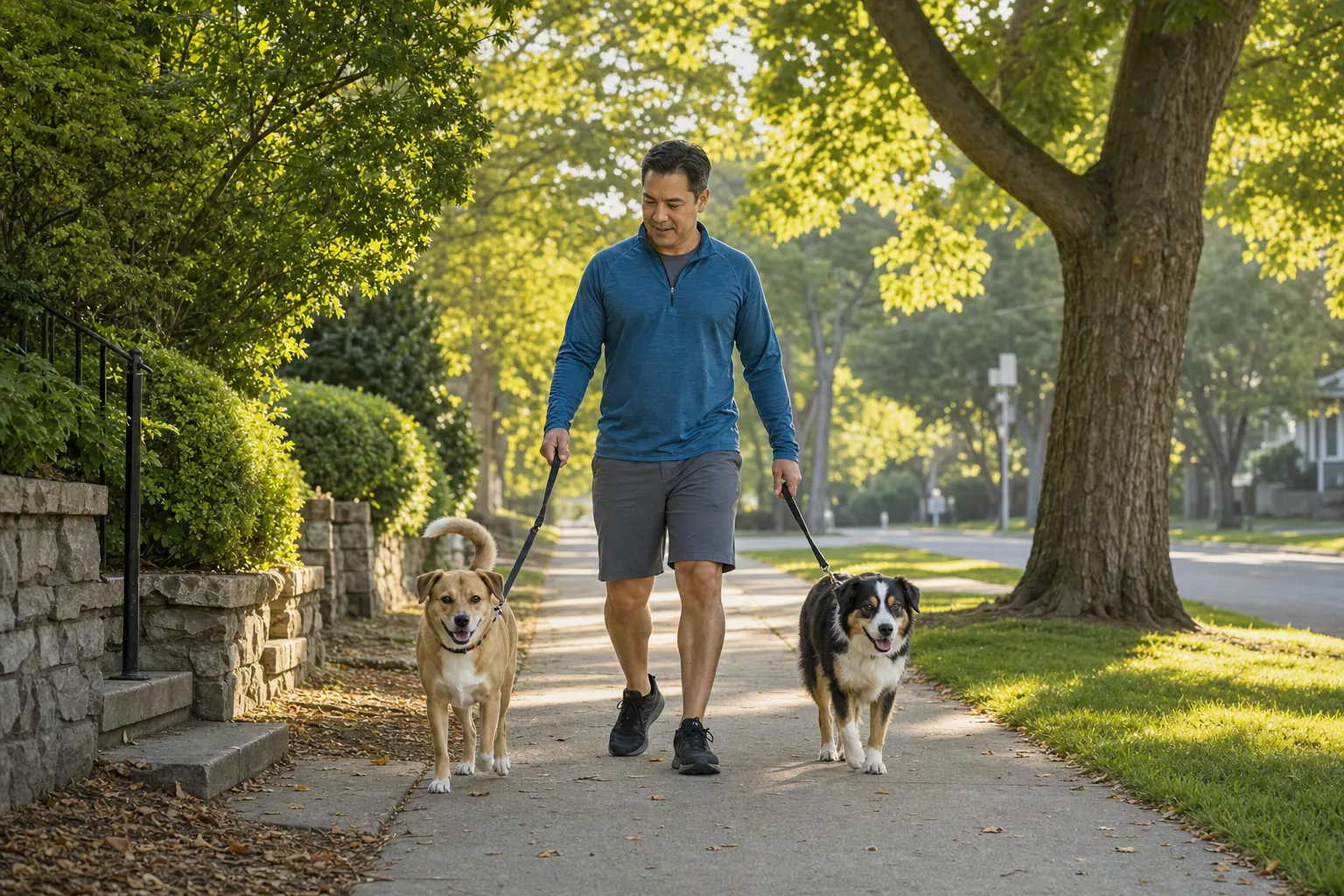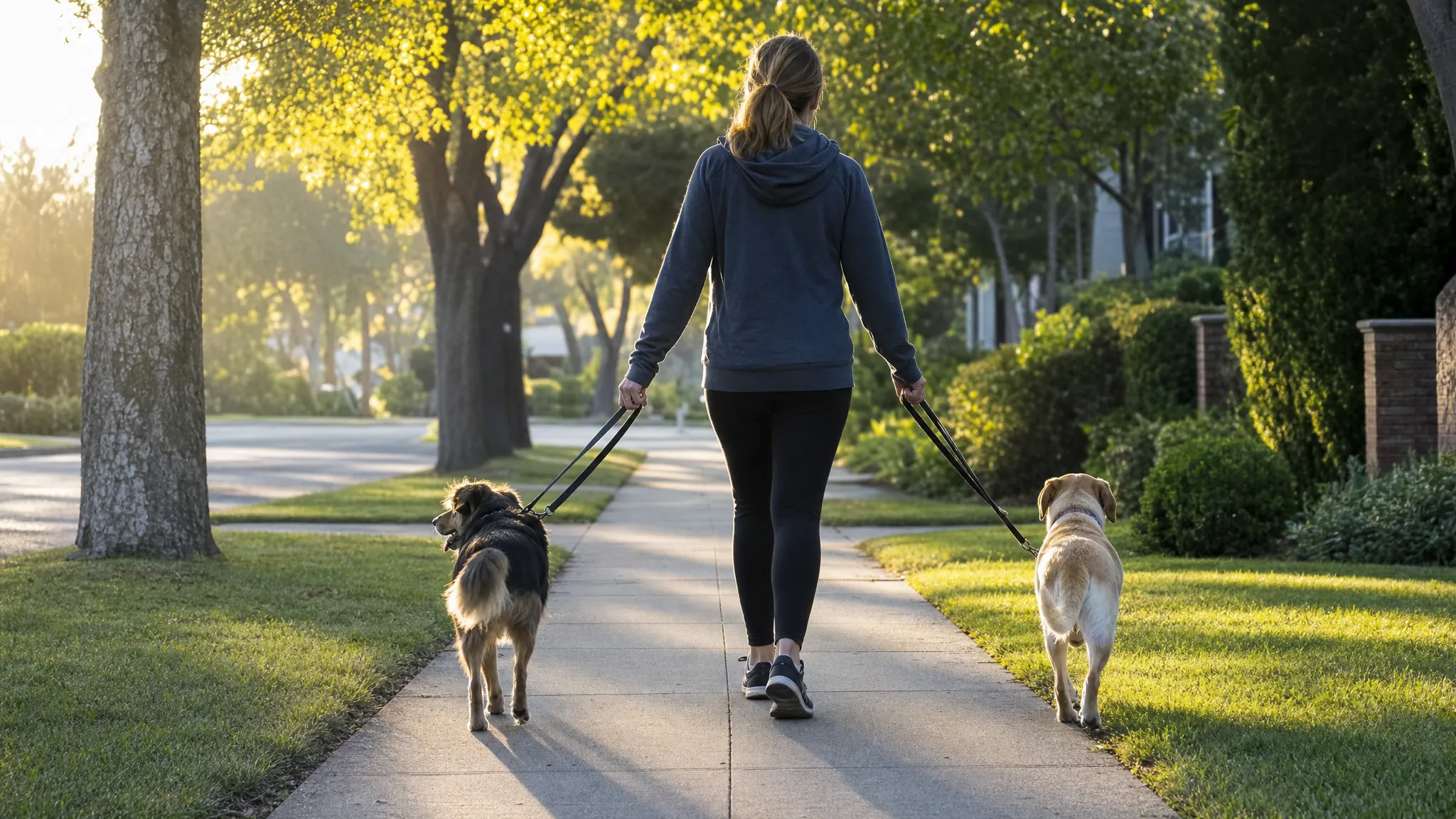

Leash walking two dogs is easiest when it starts as a training routine, not a test of grip strength. The goal is not to cover the most ground. It is to help both dogs understand where to walk, what happens when you pause, and how to move through ordinary distractions without pulling each other or you off course. A calm shared walk is built from small, repeatable choices.
1. Build the skill one dog at a time first
Before combining walks, give each dog a chance to show what they can do alone. They do not need a competition-style heel, but each dog should be able to walk on a loose enough line that you can stop, turn, and continue without a tug-of-war. That means the dog can notice a squirrel, person, or smell without immediately dragging you toward it, and can settle again when the route changes.
This matters because a second dog adds movement, excitement, and another leash line to every decision. If one dog surges ahead, the other often follows. If one gets worried, the other may become curious or tense. The Animal Humane Society's loose-leash routine is built around short, rewarding repetitions. That is a useful foundation for each dog before asking them to work as a pair.
There is no shame in keeping solo walks for a while. A young dog, a dog returning from illness, or a dog that gets overwhelmed near traffic may simply need more individual attention. Separate walks are not wasted time. They are where you build the control that makes a shared walk safer later.
2. Choose a simple setup for the first sessions
For early practice, use two standard leashes and secure, well-fitted collars or harnesses. Independent leashes let you shorten one dog's distance or guide one dog around a distraction without pulling the other dog into the same correction. They also show you which dog is creating tension, rather than turning both dogs into one tangled problem.
Set out the routine before you open the door: waste bags, treats if you use them, water for a longer or warm walk, and anything else you normally carry. Check each clip and connection point. The American Kennel Club's guide to choosing a dog leash recommends starting training with a manageable fixed length, commonly four to six feet. With two dogs, the important part is having enough room for a natural stride without giving the pair enough slack to crisscross in front of you.
Pick a side for each dog and keep it consistent. It can be left and right, or it can be one dog closer to the grass and the other closer to the curb. The exact arrangement is less important than repeating it. Predictable sides make it easier for the dogs to understand the picture and give you an obvious reset when they drift.

3. Start with a route that is deliberately easy
The first leash-walking sessions with two dogs should be short enough that you can finish before anyone gets frustrated. Choose a quiet block, open park path, or wide area where you can turn around without squeezing past people, bicycles, or other dogs. Skip the busy trail, the school pickup line, and the narrow sidewalk for now. You are teaching a pattern, not proving that the pair can handle the hardest route.
Begin with both dogs on their assigned sides. Take a few steps, pause, then move again when the leashes are loose. Keep the pace unhurried. If you use treats, reward the position and attention you want rather than trying to feed both dogs continuously while walking. A short sequence of loose steps, pause, and restart gives both dogs a clear answer about what makes the walk continue.
Five calm minutes is enough for a first session. Turn back while the routine is still working. A brief success teaches more than a long walk filled with pulling and crossed lines. Repeat that same easy route a few times before asking the dogs to manage more distance, more speed, or more distractions.
4. Teach the pair to follow your pace
Two dogs tend to speed each other up. One notices something ahead, the other sees the movement, and suddenly you are trying to manage a group that has chosen its own pace. The simplest answer is to make your own pace meaningful. When the lines are loose, keep moving. When either dog pulls, slow down or stop. When both dogs return to a manageable position, continue.
Keep your hands close to your body and gather only the extra leash you can manage neatly. Avoid wrapping a leash around your wrist. A calm, steady hold is safer than a tight grip that leaves you braced for a pull. Think of the leashes as safety connections, not steering wheels. Your direction, pace, pauses, and repeated side assignments do most of the teaching.
Do not expect perfect synchronization. One dog may naturally walk half a step ahead while the other likes to sniff at the edge of the path. You are looking for loose lines and enough attention to make a simple turn, not identical paw placement. When the pair is loosely connected to you, there is room for normal dog behavior without losing control.
5. Use wide turns before you need an emergency reset
A gentle turn is one of the most useful skills in leash walking two dogs. Practice it on an open path before you rely on it near a distraction. Use the cue you normally use, turn in a broad arc, and give the dogs room to follow without cutting across your knees. Practice both directions so one side does not become the confusing side.
Wide turns work because they change the picture without adding pressure. Instead of trying to pull two dogs backward from the end of their leashes, you move them into a new direction they can follow. This is especially helpful when you spot another dog, a runner, or a delivery truck before your pair gets too close.
If the dogs cross, stop first. Do not try to untangle them while everyone keeps walking. Guide the dog that crossed around the outside, return each dog to their usual side, and restart only when the lines are loose. The no-tangle double dog leash guide explains why an early reset matters more than any claim on a leash package.

6. Plan for the distractions you can see coming
The hard moments on a two-dog walk are usually predictable. Another dog appears down the block. A child runs toward the sidewalk. A noisy truck stops nearby. Get in the habit of looking ahead often enough that you can make an easy choice while there is still space. Cross the street, turn down a quieter side path, step into a wide driveway, or pause at a distance.
More room is not a failure. It is a practical way to keep two dogs from becoming more excited than you can comfortably manage. The American Kennel Club's advice on walking multiple dogs also emphasizes practicing basic skills before adding the group. With two dogs, early choices are far easier than late corrections.
Pay attention to what each dog needs. One may be fine passing a stroller while the other needs a wider arc. One may need to slow down on a hot day while the other seems ready for more. The ASPCA's dog-care guidance includes ordinary walk basics such as identification, water, and checking heat conditions. Those details deserve extra attention when you are managing two separate needs at once.
7. Know when to return to separate leashes and solo practice
Shared walks are not the best fit every day. Use individual walks when one dog is learning loose-leash skills, recovering from illness or injury, reacting strongly to people or animals, or moving at a very different pace from the other dog. Separate leashes are also sensible on a new route, around heavy traffic, or in a crowded setting where each dog might need independent guidance.
It also helps to separate walks by purpose. One dog may benefit from a slow sniffing route, while the other needs a steadier exercise pace. One may enjoy meeting familiar people, while the other needs more distance. Trying to make both dogs have the same kind of outing can make the walk harder than it needs to be.
For a fuller walkthrough of first shared outings, see How to Walk Two Dogs at Once. It covers readiness, short practice routes, and the point where it is kinder to split the pair up again.
When a double leash may fit the routine
Once both dogs can walk at a similar pace, return to their sides after a pause, and move through normal distractions without sustained pulling, a shared setup may reduce the number of handles you carry. It should support a routine that already works, not replace the basic training that makes the routine safe.
The Broken Phoenix carries an Automatic Double Dog Leash with two independently extending lines for households whose dogs are already comfortable walking together. Compare the current product details with your dogs' size, leash manners, and usual route. Keep separate leads available for training days, crowded places, and any walk where the dogs need different amounts of room.

A simple checklist for the next walk
Start with two dogs who can each walk reasonably well on their own. Use two standard leashes for early practice. Give each dog a consistent side. Choose a quiet, short route. Pause when the lines tighten and move again when they loosen. Turn early around distractions. Stop to reset a crossing. Finish while the walk still feels manageable.
That sequence is not flashy, but it works because it gives both dogs the same clear pattern every time. Once the pattern feels ordinary, you can gradually add distance and busier surroundings. For more practical gear, browse the pet supplies collection or the full store. The shipping policy and return policy explain the practical details before ordering.
Frequently asked questions
How do I stop two dogs from pulling each other on walks?
Begin with each dog's loose-leash skills separately, then use short shared practice walks on an easy route. Pause or slow down when either leash tightens and continue when both dogs return to a manageable position. Consistent sides and early turns make the pattern easier to understand.
Should I use a double leash while training two dogs?
Two separate standard leashes are usually the clearer training choice because you can guide each dog independently. A double leash can be useful after both dogs already walk calmly at a similar pace and do not need different levels of help.
What should I do when my two dogs cross leashes?
Stop before the lines become tight. Guide the dog that crossed around the outside with enough room to return to their usual side, then continue once both lines are loose. Avoid trying to untangle the dogs while they are still moving.